


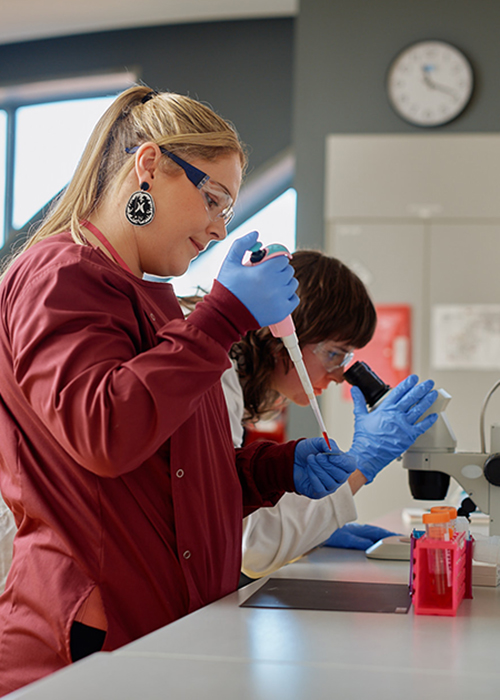
“I remember asking my mum, why couldn’t they give him any medicine to make him any better? And she explained to me that not all illnesses have a cure,”
Hannah’s childhood determination to help her cousin grew into a passion for medical research and human health.
Hannah Coombe’s passion for medical research and human health began when she was five years old and her cousin was born with an illness that had no cure.
“I remember asking my mum, why couldn’t they give him any medicine to make him any better? And she explained to me that not all illnesses have a cure,” Hannah said.
“And I said well, one day I’ll go make a cure and help him get better.”
After finishing year 12, Hannah enrolled in the University of Tasmania’s Bachelor of Medical Research (now the Bachelor of Biomedicine), eventually completing her degree with first-class honours. And she has recently submitted her PhD in stroke research.
“Pericytes are cells located on the small blood vessels throughout the body that have important roles in regulating blood flow,” she said.
“As stroke is caused by impaired cerebral blood flow, we think pericytes may have important roles in stroke and perhaps we can target them for novel stroke treatments in the future.”
Staying in Tasmania allowed her to remain close to family and friends during her studies, while also being able to learn from world-class researchers.
Hannah especially loved how practical the degree was, which helped her to understand the course content in a deeper, more applied way.
“I thought uni would just be lectures and note-taking, but there were so many hands-on classes. You could apply what you learned in real time, and it made things click,”
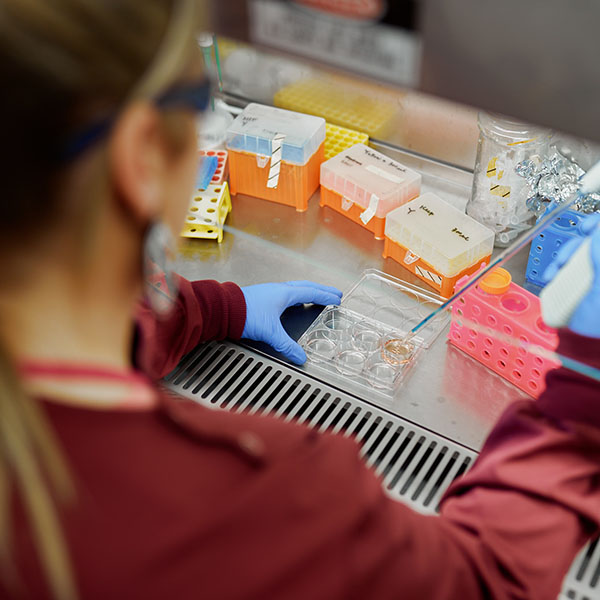
Her favourite classes were physiology, studying how the human body works and how it heals.
“It’s a really fascinating thing, there’s so many things we still don’t know about the human body,” she said.
“And medical research comes in, exploring these unknowns, and to do that you need a solid grasp of what we do know, so you can implement that in answering the questions.”
Like many students, the biggest challenge was adjusting to the independence of university life. But Hannah said the skills she gained in self-management and self-motivation were invaluable for her academic journey.
Also invaluable were the two scholarships she received along the way, including a summer research internship.
“That was my first time working in a big lab. It confirmed this was what I wanted to do.”
Since completing her PhD, Hannah has remained at the University to continue her post-doctoral research into pericytes and stroke, and eventually she hopes to combine research with teaching. During her PhD she had the opportunity to teach undergraduate students, which was when she discovered a passion for inspiring the next generation.
Because, if there’s one thing she learned, it was the value of curiosity and inquiry.
“Don’t be afraid to talk to your lecturers, they’re really approachable and there’s no such thing as a silly question.”
Story courtesy of University of Tasmania

Find out more
Explore study options such as the Bachelor of Biomedicine at the University of Tasmania. Build expertise in anatomy, physiology, genetics, and molecular biology, with hands-on experience in advanced laboratories and research projects. This degree offers pathways to careers in medical research, diagnostics, pharmaceuticals, and health technology.
Even while you’re still in school, you can begin building your future through Work-based Learning (WBL), School-based Apprenticeships (ASbA), and VET qualifications. These programs give you hands-on experience and real-world skills to prepare for a successful career in biomedicine.
Take a quiz, find your future
Curious about the kinds of problem‑solving involved in different jobs? Our Industry Quizzes webpage offers a range of short activities that aren’t formal tests of reading or maths, but they can give you a clearer sense of the skills you already use and the ones you might want to build.